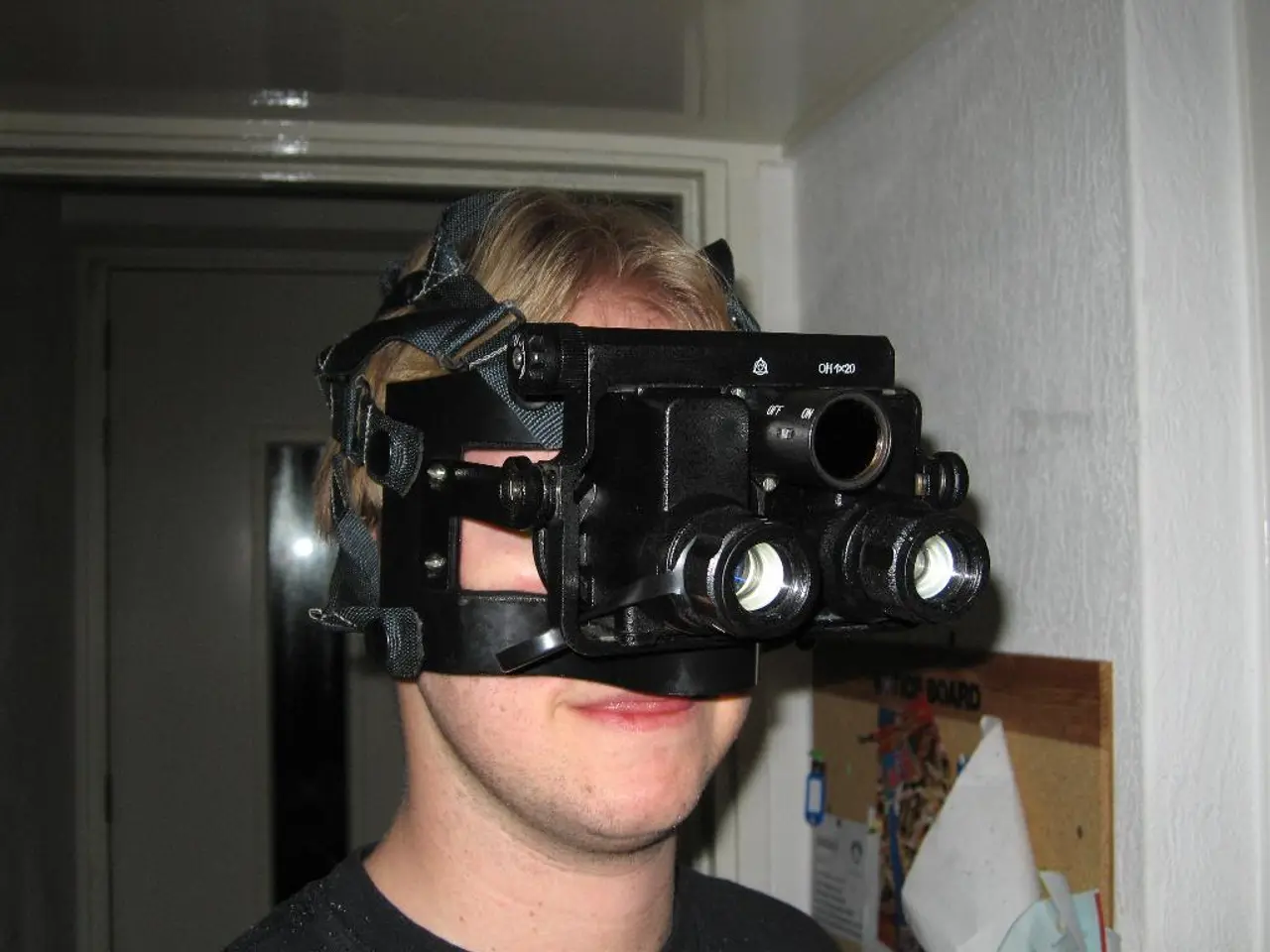
Virtual Reality (VR) currently faces numerous challenges, with smart glasses being a significant contributing factor to its predicament.
In the ever-evolving world of technology, the virtual and augmented reality markets are experiencing robust growth, driven by technological advancements, consumer adoption, and expanding applications. The combined AR & VR market is projected to surge at an impressive CAGR of around 35-38% through 2034 [1][2][4].
Among the most intriguing developments in this space are XR/AR smart glasses. Major industry players like Meta and Apple are investing heavily in these devices, with Meta unveiling a multi-year hardware roadmap including smart glasses and wearable devices for 2025 onward [2]. The AR headset segment currently holds the largest share in the AR/VR headset market and is projected to keep growing strongly, especially in enterprise sectors [4].
Industry leaders emphasize AI integration, enhanced displays, improved motion tracking, and standalone headset innovations as key drivers pushing boundaries in both XR and AR wearables. The future outlook for XR/AR smart glasses is optimistic, with expected revenue expansions linked to their combination of AR functionalities and wearable convenience, which differentiate them sharply from traditional VR headsets [2][4].
While VR remains strong in immersive experiences and entertainment, especially social VR shopping, e-commerce integration, and gaming [1][3], AR is growing rapidly due to its ability to overlay digital content on the real world, useful for enterprise, retail, automotive, education, healthcare, and more [2][3][4].
One of the key advantages of smart glasses over VR headsets is their light form factor, making them suitable for extended wear without discomfort. In contrast, strapping a headset to one's face, even the lightweight and comfortable Quest 3, can become invasive and uncomfortable over time [5].
The latest rhetoric around smart glasses and XR/AR comes from Apple's Tim Cook and Meta's Mark Zuckerberg, who both emphasize the potential of these devices to revolutionize everyday life [6]. The Quest 3S, for instance, offers an XR experience that appeals to both established XR/VR fans and beginners, making it a suitable headset for the current market [7].
Despite their potential, smart glasses are still a work in progress. They do not yet have a display, but industry leaders are working tirelessly to overcome this challenge [5]. The tides in emerging tech, particularly in smart glasses and XR/AR, seem to be turning, and the future promises exciting developments in this field.
[1] [Market Research Reports] (https://www.marketsandmarkets.com/Market-Reports/virtual-reality-market-204234980.html)
[2] [Meta's Hardware Roadmap] (https://about.fb.com/news/2022/04/meta-announces-multi-year-hardware-roadmap/)
[3] [VR and AR in Retail] (https://www.forbes.com/sites/forbesagencycouncil/2021/03/18/why-virtual-reality-is-the-future-of-retail/?sh=62e87d9f160a)
[4] [AR/VR Headset Market] (https://www.grandviewresearch.com/industry-analysis/augmented-reality-market)
[5] [Quest 3 Comfort] (https://www.cnet.com/tech/gaming/oculus-quest-3-vr-headset-is-coming-and-it-could-be-a-game-changer/)
[6] [Tim Cook and Mark Zuckerberg on AR] (https://www.cnbc.com/2021/03/29/tim-cook-and-mark-zuckerberg-discuss-the-future-of-augmented-reality.html)
[7] [Quest 3S] (https://www.theverge.com/2022/4/25/23045445/oculus-quest-3s-vr-headset-price-specs-release-date-features)
- In the technology industry, the future looks promising for XR/AR smart glasses, with market leaders like Meta and Apple investing heavily in their development.
- The AR headset segment currently holds the largest share in the AR/VR headset market and is projected to keep growing strongly, particularly in enterprise sectors.
- While VR remains strong in immersive experiences and entertainment, AR is growing rapidly due to its ability to overlay digital content on the real world, useful for various sectors like enterprise, retail, automotive, education, healthcare, and more.
- One of the key advantages of smart glasses over VR headsets is their light form factor, making them suitable for extended wear without discomfort.
- Despite their potential, smart glasses are still a work in progress, and industry leaders are working tirelessly to overcome challenges, such as developing displays for these devices.




%20currently%20faces%20numerous%20challenges%2C%20with%20smart%20glasses%20being%20a%20significant%20contributing%20factor%20to%20its%20predicament.)