Investigative Expedition week 1: Sailing the seas with research ship Tangaroa
The Tangaroa: New Zealand's Antarctic Research Vessel
The RV Tangaroa, operated by the National Institute of Water and Atmospheric Research (NIWA) in New Zealand, is a 70-metre ice-strengthened deepwater research vessel designed for Southern Ocean and Antarctic scientific missions.
Equipped for Antarctic Research
The Tangaroa is New Zealand's only ice-strengthened research ship, enabling it to safely operate in icy and harsh Antarctic waters. It is equipped to carry out a wide range of oceanographic, atmospheric, and ecological research, including deepwater and coastal studies.
On board, there are several laboratories dedicated to running experiments. These include a dry lab with computers, plankton nets, and underwater cameras; a plankton lab; an area where animals from the seafloor are sorted, identified, and preserved; a sterile lab for preparing samples for bacterial work; a wet lab where fish are measured and identified and samples are taken; a constant temperature lab for bacterial work; and -30°C and -80°C freezers for sample preservation.
Navigating Antarctic Waters
The Tangaroa is equipped with a variety of sounders, including fish finders, full ocean depth echo-sounders, and a multibeam sounder. The ship's engine is kept running by two engineers. The Officer of the Watch uses a small wheel, the size of a peanut butter jar lid, to turn the ship, and pushing or pulling a lever the size of a biro makes the ship stop, move forward at 15 knots, or move astern at 8 knots.
The Tangaroa moves like a giant skateboard, measuring 70 metres in length and weighing 3,000 tonnes. It has an ice rating that allows it to break through 0.3 metres of year-old sea ice and push older floes out of its path. The vessel carries three other craft: the 10.5 meter survey boat Pelorus and two rigid inflatables.
Safety Measures for Antarctic Operation
Given Tangaroa's role as New Zealand's Antarctic-capable research vessel, it would meet all international safety and operational standards to conduct scientific missions in Antarctic environments. Typical standards for Antarctic research vessels like the Tangaroa involve compliance with the International Code for Ships Operating in Polar Waters (Polar Code), ice-strengthening to withstand collision with pack ice, onboard safety equipment for cold water survival and emergency evacuation, navigation and communication systems modified for polar region challenges, and carrying an experienced ice pilot.
Onboard Facilities
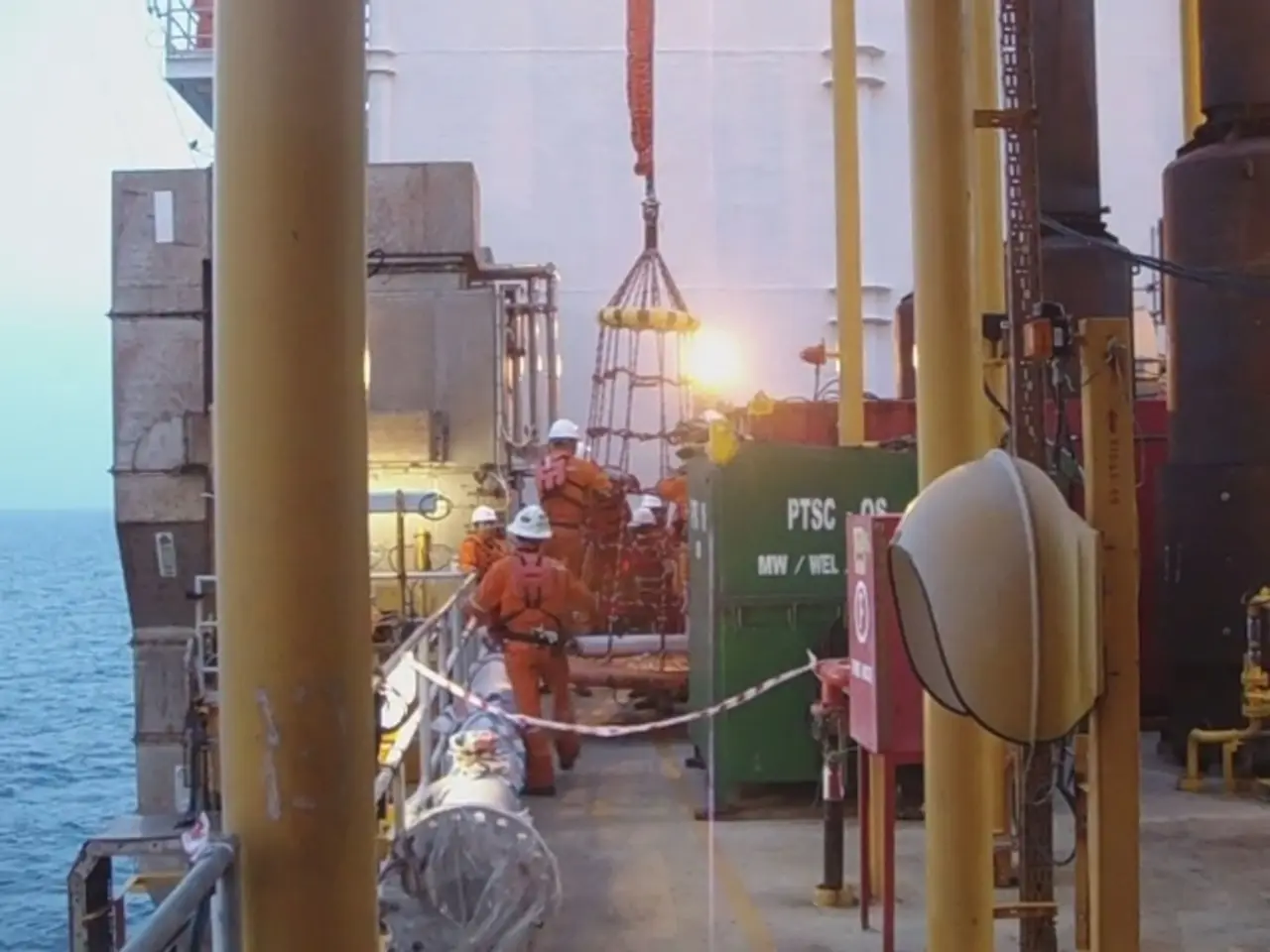
The Tangaroa is well-equipped to support its crew and science personnel. The lowest deck below the waterline contains the ship's computer system and multibeam echo-sounder. On the trawl deck on top, there is a DTIS and CTD equipment station. A camera work station on board is used for monitoring data from the DTIS cameras.
The ship has a fully equipped hospital and carries a doctor for the trip. The engineers perform various roles, including electrician, plumber, welder, fitter, and washing machine repairer. The ship carries a maximum of 44 people, with 26 science personnel and the remainder being crew on a voyage to the Ross Sea. The ship is equipped with sufficient emergency gear for all personnel to survive on shore for several days.
In summary, the RV Tangaroa is a 70-metre, ice-strengthened research vessel equipped for Antarctic scientific work with necessary safety features for polar operations, operated by NIWA in New Zealand.
- The Tangaroa, an Antarctic research vessel, is outfitted for various environmental-science projects, such as data-and-cloud-computing to analyze climate-change data gathered during its missions.
- With advanced technology onboard, like a multibeam sounder and a dry lab for computers, the Tangaroa's research capabilities extend to data collection and analysis in the realm of science, aiding in the understanding of the Antarctic ecosystem.